 5th·6-8
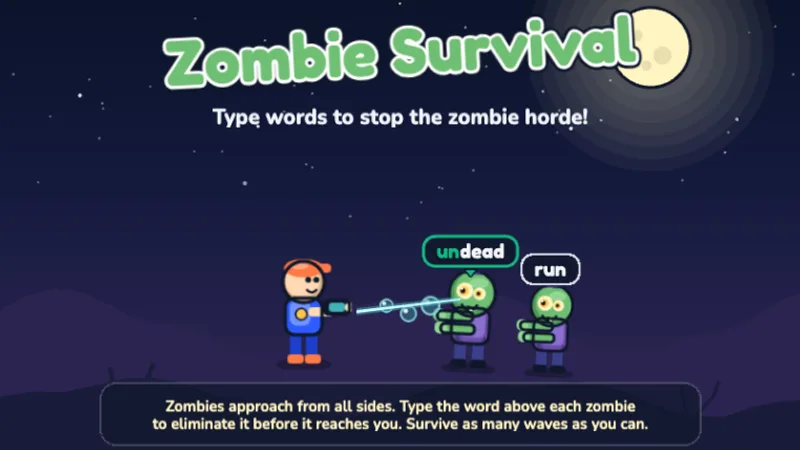
Zombie Survival
Type words to stop the zombie horde — survive as many waves as you can!
★★★★★
Ages 10-14
Words
Speed
Middle schoolers need speed, accuracy, and endurance. These games push past 35 WPM with longer passages, timed challenges, and themes that match the maturity of older students.
⌨️ Quick answer: The working target for middle school is 35 to 50 WPM with 95 percent accuracy. 35 WPM is functional, 40 WPM is comfortable, and 50 WPM puts a student ahead of most adults.
Middle school changes everything about typing. Homework doubles, nearly all of it typed. Research papers require sustained keyboard time. Timed standardized tests punish slow typists. And teachers stop teaching typing — they assume the skill is already there. A student who enters 6th grade at 35 WPM or above handles all of this without thinking about it. A student at 20 WPM spends the next three years fighting the keyboard on every assignment. The gap between those two students is not talent — it is practice. And middle school is still early enough to close it. Find out which student you have: run the test, then see whether 35 WPM is good at this age before deciding how much practice is actually needed. The typing speed test for kids here is one minute, needs no account, and reports WPM and accuracy so you can retest monthly. The typing games for 6th graders on this page are the same set 7th and 8th graders use; only the word lists get longer. Students already past the letter stage, and parents practicing alongside them, can also use the typing games for adults collection.
Middle schoolers will not play anything that looks like it was made for a 6-year-old. The games below are the subset of our online typing games for kids that hold up for older students.
No login, no ads, instant play.
5th·6-8
Type words to stop the zombie horde — survive as many waves as you can!
 6-8
6-8
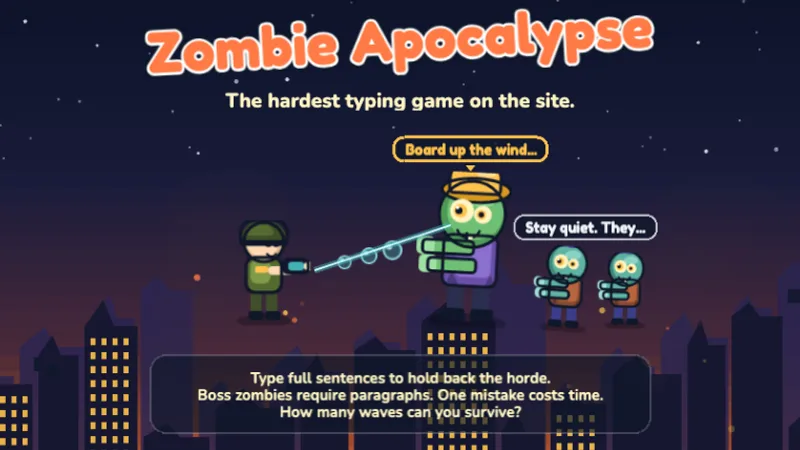
The hardest typing challenge — type sentences and paragraphs to survive the apocalypse!
 5th·6-8
Sentence-level head-to-head race against a faster AI — can you keep up?
 4th·5th·6-8
Guitar Hero meets typing — type words as they scroll down the stage!
Zombie Survival is the entry point for middle school practice. Zombies approach from all directions carrying words — type them before they reach you. The pace ramps steadily across waves, starting at a comfortable 25 WPM and pushing toward 40 by wave 10. The zombie theme is engaging without being childish, which matters at this age.
Zombie Apocalypse is the hardest game on the site. Full sentences and short paragraphs come at you from multiple directions, with boss zombies requiring sustained bursts of accurate typing. Designed for students already at 35 WPM who want to push toward 50. If your middle schooler can clear wave 15, they are typing faster than most adults.
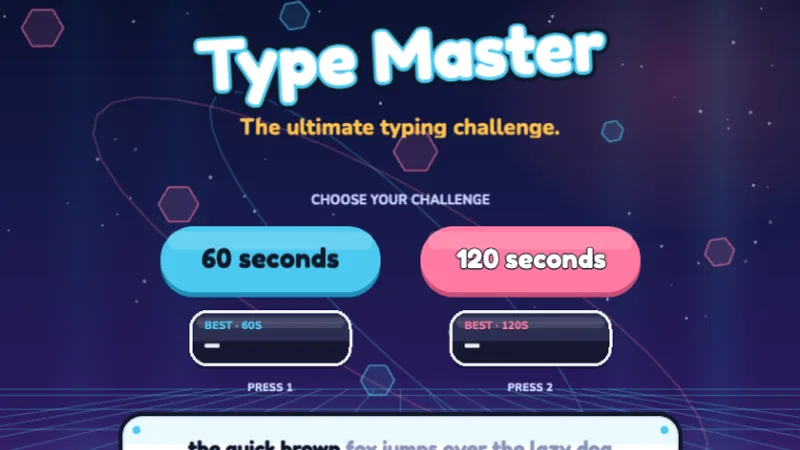
Type Master remains relevant at the middle school level as a benchmark tool. Its 60-second timed challenge with WPM-times-accuracy scoring is the closest thing to a standardized typing test on the site. Use it monthly to track progress.
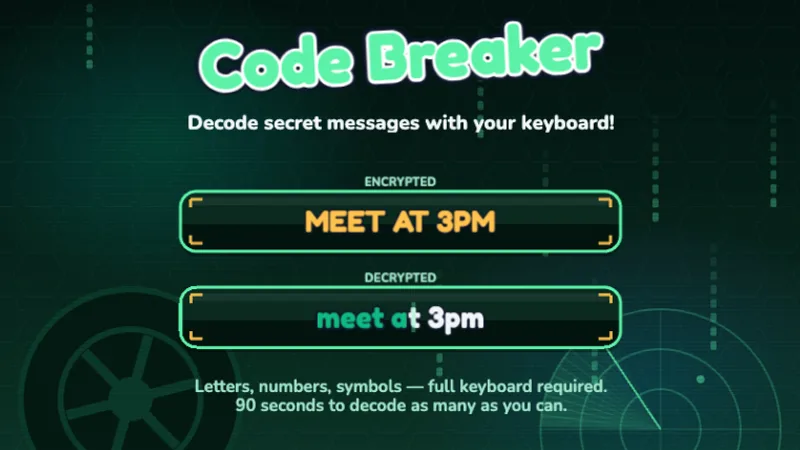
Code Breaker pushes full-keyboard mastery including numbers and symbols — skills that become essential for middle school math, science notation, and the first exposure to coding. A good warm-up game that keeps the entire keyboard active.
Middle school typing is about fluency under pressure. Students type essays, timed tests, and research papers — all requiring sustained speed with minimal errors. The games at this level reflect that reality with longer text, faster pacing, and scoring that rewards both speed and accuracy.
Middle school typing speed matters more than elementary speed because the volume of typed work increases sharply. A 6th grader with a 500-word essay assignment at 20 WPM spends 25 minutes just getting words on screen. At 40 WPM that same essay takes 12 minutes of typing, leaving twice as much time for thinking, revising, and editing. Over a school year with dozens of typed assignments, that time difference compounds into a real academic advantage. The benchmark progression across middle school is roughly 35 WPM in 6th grade, 40 in 7th, and 45 in 8th — but these are averages, not requirements. A student at 30 WPM with clean touch-typing habits will naturally gain speed through daily school use. A student at 30 WPM with hunt-and-peck habits will stay there without deliberate practice.
Middle school typing practice is about targeted improvement, not building from scratch. Most students at this level have been typing for years — the plan is to identify and fix the specific weakness holding them below their potential.
A one-minute test is too short for middle school diagnosis. Run a two-minute test and check: does speed drop in the second minute (endurance problem), do errors spike on longer words (accuracy problem), or is the overall number just low (speed problem)? Each has a different fix.
Twenty minutes a day, five days a week, for four weeks. Alternate between Zombie Survival for engagement and Type Master for measurement. Most middle schoolers gain 8-12 WPM in a focused four-week sprint. After that, drop to maintenance mode.
Three 15-minute sessions per week is enough to maintain and slowly build speed. Use Zombie Apocalypse for challenge and Code Breaker for full-keyboard variety. Speed gains above 30 WPM come from daily school typing more than from game practice.
The best middle school typing practice is actual homework. Encourage your student to type first drafts directly instead of handwriting and then retyping. The speed and accuracy needed for real writing is slightly different from game typing, and the only way to build it is to do it.
Most middle schools do not have a dedicated keyboarding class, which means typing practice has to be embedded in existing instruction. The highest-leverage approach is a five-minute typing warm-up at the start of ELA or computer class — Zombie Survival or Type Master on screen, headphones in, timer visible. Five minutes is short enough that it does not eat into instructional time and long enough to maintain skill. Teachers who do this consistently report measurably faster student essay output by mid-year.
Individual devices and self-paced practice. Middle schoolers are self-conscious about being seen as slow typists — whole-class speed displays or competitive typing races embarrass struggling students and reinforce avoidance. Let each student work at their own level privately.
Five to ten minutes as a warm-up embedded in another class is the sustainable model. Dedicated 30-minute typing blocks are hard to justify in the middle school schedule and produce diminishing returns past the 15-minute mark for most students.
By middle school, typing practice is less about learning and more about maintaining. A few 15-minute sessions per week keeps skills sharp. If your child is below 30 WPM entering 6th grade, focused daily practice for 4-6 weeks usually closes the gap.
My 6th grader types 18 WPM and middle school just started.
This is behind but absolutely recoverable. An 18 WPM 6th grader who practices twenty minutes a day for six weeks typically reaches 28-32 WPM — enough to handle middle school workloads without struggling. The practice window is now, before homework volume makes it hard to find time. Start with Zombie Survival for engagement and add a weekly Type Master test to track progress.
They only use two fingers and refuse to learn touch typing.
Two-finger typing has a hard ceiling around 30-35 WPM. If your middle schooler is already near that ceiling, pushing for touch typing may not be worth the battle — they can function in school. If they are below 25 WPM with two fingers, the investment in touch typing pays off: two weeks of slower, frustrating practice followed by months of faster improvement. Frame it as a practical skill, not a school assignment.
They say typing games are for little kids.
Fair point — and that is exactly why the zombie games exist. The theme, pacing, and difficulty are designed for the middle school age group. If games still feel too young, shift practice to real-world typing: timed essay prompts, typing out song lyrics, or copying passages from books they are reading. The motor skill builds the same way regardless of what the text says.
The complete WPM benchmark table including middle school targets at 6th through 8th grade.
Where middle school typing speed fits in the full spectrum from elementary through professional adult typing.
By middle school, typing is the dominant writing tool — but handwriting still matters for note-taking and exams.
Behind on typing? This step-by-step guide takes any beginner from zero to confident typist in 8-12 weeks with free games.
If your middle schooler needs to build foundations first, the 5th grade games and benchmarks are the right starting point.
Our grade-level targets align to U.S. keyboarding standards and published research:
Last reviewed June 2026 · TypingGamesKids. See the full typing speed by age guide.
Take a Typing Test
Start Typing Test